Back to insights


AI in data analytics - how it can help you up your game

4 min read
14th May, 2024
 Written by Alex Benfield
4 min read - 23rd December, 2025

There's a particular type of person who announces, with great confidence, that they "don't really use AI" as though abstaining from a useful tool were a mark of intellectual superiority rather than stubbornness.
There's another type who uses it for everything, producing reams of content with the distinctive flavour of having been written by nobody in particular.
Both have missed the point.
After spending an unreasonable number of hours experimenting with these tools, I've arrived at a fairly boring conclusion: AI is useful in the way that a sharp research assistant is useful. It can gather, organise, summarise, and generate options. What it cannot do is think on your behalf.
Nor should you want it to.
The standard approach to AI goes something like this: open ChatGPT, type a question, receive an answer, feel vaguely disappointed, close the tab. Repeat weekly while wondering what all the fuss is about.
The issue is one of context. When you ask a general question, you receive a general answer. The model knows nothing of your industry, your standards, or your particular circumstances. It has no idea what "good" looks like in your world. So it produces something safe and average. The written equivalent of a hotel room painting.
This is not a flaw in the technology. It's a flaw in how we're approaching it.
The shift that actually matters is treating AI as a collaborator rather than an oracle. You provide context, direction, and judgment. It provides speed, breadth, and tirelessness.
Most tools now allow you to create dedicated workspaces with persistent instructions and reference documents. This is where the leverage comes from. A workspace primed with your company's positioning, examples of work you admire, and relevant industry knowledge will produce dramatically better outputs than a blank chat window.
It's the difference between briefing a new hire properly and shouting instructions across a crowded room.
Most people default to ChatGPT because it's the name they know. Fair enough. But it's worth being aware that alternatives exist.
Claude, built by Anthropic, is one of the main competitors. Fewer people use it, which is partly why (I believe) its outputs tend to sound less like the AI-generated content we've all learned to recognise. I've found it noticeably better for writing, creative work, and strategic thinking. The outputs feel less like they were assembled by committee. ChatGPT often edges ahead for technical tasks and coding.
Test both. Use whichever produces results you're happier with. This is not a religious matter.
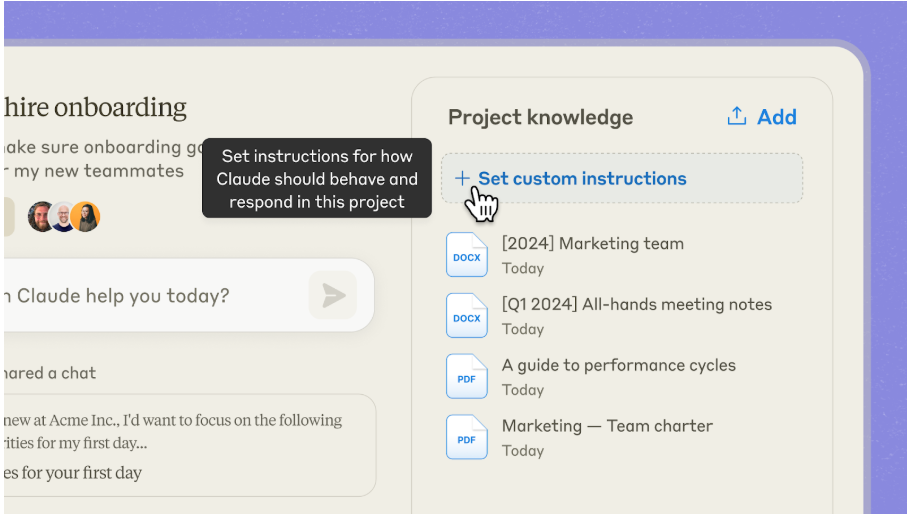
Here's where things get practical. If you want AI to produce genuinely useful output, you need to give it context it can reference. In Claude, this is done through "Projects".
A Project is essentially a private workspace. You give it custom instructions (a system prompt that runs before every conversation) and upload relevant files. The model will prioritise this information over generic web knowledge. You can upload style guides, past work you're proud of, industry reports, competitor examples, even entire books if they're relevant to the task.
The difference is substantial. I tested this with keyword research for an e-commerce brand. Using a standard Claude chat, I got a basic list of obvious suggestions. Helpful, but nothing I hadn't considered. Using a properly configured Project with relevant industry documents, competitor research, and best practice guides, I got categorised opportunities with match type recommendations, intent analysis, and priority rankings. Same question. Completely different depth.
Writing effective prompts is tedious. Most of us aren't naturally good at it, and the cottage industry devoted to "prompt engineering" produces material that is, frankly, sleep-inducing.
Here's the workaround: create a dedicated Claude Project whose sole purpose is to help you write better prompts.
Upload Anthropic's own documentation on effective prompting. Give it instructions to reference this guide when you ask for help structuring a request. Then, whenever you need a complex prompt, describe what you're trying to achieve in plain English and let the model generate a properly structured version.
It sounds circular. It works remarkably well. The model knows what information it needs to perform at its best. Let it tell you.
I've found AI most valuable for the unglamorous groundwork that precedes actual thinking.
Gathering and summarising research. Processing long documents or transcripts. Surfacing patterns in data that would take hours to spot manually. Generating multiple options to react to rather than staring at a blank page. Pressure-testing an argument by asking the model to poke holes in it.
These are tasks that benefit from speed and scale. The strategic and creative decisions that follow remain yours.
Where I've found it less useful: anything requiring genuine taste, voice, or judgment. Final copy. Strategic recommendations. Work that needs to feel like it came from a specific human mind rather than a statistical average of all human minds.
AI does not make expertise obsolete. If anything, it makes expertise more valuable. The people extracting genuine use from these tools are not outsourcing their thinking. Rather, they're arriving at decisions with better inputs and less drudgery.
The technology handles the legwork. The human handles everything that matters.
Which, when you think about it, is how most useful tools have always worked. We simply expected this one to be more “magical” than it is.